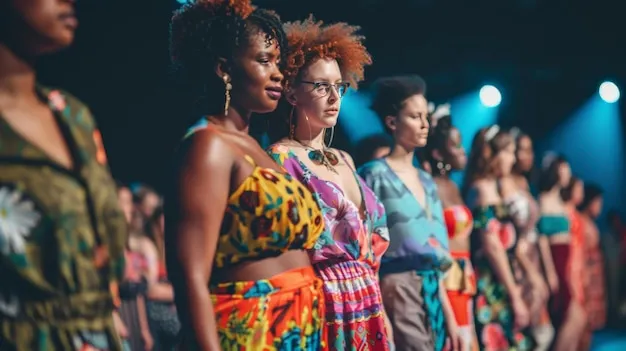
Stan Culture Hits the Runway: How Fan Communities Are Building Their Own Philanthropic Fashion Moments
Photo: Riksarkivet (National Archives of Norway) from Oslo, Norway, No restrictions, via Wikimedia Commons
If you picture a charity fashion show, you might imagine a ballroom, a seated dinner, maybe a celebrity auctioneer. What you probably don't picture is a Discord server with 40,000 members coordinating handmade looks inspired by a beloved anime series, all to raise money for a mutual aid fund.
But that's exactly what's happening — and it's happening at a scale that the traditional philanthropic fashion world is only beginning to notice.
Across the United States, passionate fan communities are organizing their own benefit runway events, styling competitions, and virtual fashion showcases tied to causes that matter to them. K-pop fandoms are raising money for Black Lives Matter chapters and LGBTQ+ youth organizations. Anime communities are funding food banks and disaster relief. Gaming crews are hosting cosplay runway events to support mental health nonprofits. These aren't fringe experiments. They're organized, intentional, and increasingly effective fundraising operations — built on the infrastructure of fandom itself.
Why Fans Are Taking This Into Their Own Hands
The short answer is that nobody asked them to — and they didn't wait to be invited.
Younger audiences, particularly Gen Z and younger millennials, have a complicated relationship with traditional charity galas. Many see them as exclusionary spaces that prioritize donor optics over actual impact. The ticket prices are prohibitive. The cultural references feel dated. And the causes being championed don't always reflect the communities those audiences care most about.
"Legacy charity events are designed for a very specific kind of donor," says one organizer who runs a K-pop fan charity collective based in Atlanta. "They're not designed for a 22-year-old who has $30 to give and a lot of passion. We wanted to create something where that person could participate fully — and feel like their contribution actually mattered."
Fan communities, by contrast, already have the social architecture for this kind of organizing. They have Discord servers, subreddits, group chats, and social media accounts with massive followings. They have people who are deeply skilled at graphic design, event coordination, content creation, and online fundraising. And they have something traditional charity events often struggle to manufacture: genuine enthusiasm.
What These Events Actually Look Like
The format varies widely, which is part of the appeal. Some fan-led fashion events are fully virtual — livestreamed runway shows where participants model their own fan-inspired looks, vote on favorites, and donate to unlock milestones. Others are in-person pop-up events at convention centers, community spaces, or college campuses, with styling competitions judged by community members and raffles featuring fan-made merchandise.
One particularly creative example: a gaming community in Seattle hosted a "Boss Level Gala" last year, where attendees styled themselves as characters from their favorite games and walked a runway judged by popular streamers. Admission was pay-what-you-can, and all proceeds went to a local youth coding nonprofit. They raised over $18,000 in a single afternoon.
In Los Angeles, an anime fan collective organized a "Cosplay Couture" showcase that doubled as a silent auction for handmade, character-inspired garments. The event raised funds for an LGBTQ+ youth shelter and sold out its registration in under 48 hours.
What makes these events work isn't just the cause — it's the culture. Participants aren't just donors; they're collaborators. They helped design the event, they're wearing something they made or curated themselves, and the cause was chosen by the community, often through a vote.
The Values Alignment Is Doing Heavy Lifting
One thing that stands out across fan-led philanthropic fashion events is how tightly the cause connects to the community's identity. K-pop fandoms have a well-documented history of mobilizing for racial justice causes, partly because many artists they support have spoken publicly about those issues. Anime communities frequently rally around LGBTQ+ and mental health causes, reflecting the values of a fanbase that skews young and often queer. Gaming communities have increasingly directed their fundraising energy toward accessibility and neurodiversity organizations.
This isn't accidental. It's what happens when the people organizing an event are also the people attending it — when there's no gap between the fundraiser and the community being asked to give.
"We don't have to convince our audience to care about the cause," says the founder of a Midwest-based anime fan charity group. "They already care. Our job is just to give them a fun, creative way to act on it."
That's a significant contrast to traditional benefit fashion events, where organizers often spend considerable energy trying to connect a cause to an audience that may not have an existing relationship with it.
What Established Fashion Nonprofits Can Actually Learn Here
It would be easy to dismiss fan-led events as small-scale or niche. That would also be a mistake.
The organizing principles behind these events — community ownership, values alignment, low barriers to participation, and creative expression as a fundraising vehicle — are not niche ideas. They're highly transferable, and several established fashion nonprofits are starting to pay attention.
A few things worth borrowing:
Let the community choose the cause. Fan events consistently outperform when participants have a say in where the money goes. Polling your audience before an event — rather than presenting them with a predetermined beneficiary — creates investment that translates into higher engagement and more donations.
Lower the floor for participation. Pay-what-you-can admission, virtual attendance options, and DIY styling categories make events accessible to younger and lower-income audiences who are often deeply passionate but priced out of traditional galas.
Treat creativity as currency. Fan communities raise money partly because participation is inherently fun and expressive. When attendees are also performers, designers, and judges, the event becomes something people talk about — and come back to.
Leverage existing community infrastructure. Fan groups already have audiences, moderators, and communication channels. Partnering with established fan communities rather than building from scratch can dramatically expand reach without proportionally expanding budget.
The Runway Belongs to Everyone
There's something genuinely exciting about watching a 19-year-old in a handmade Sailor Moon-inspired look walk a runway she helped organize, raising money for a cause her community voted on together. It's fashion as advocacy in its most unfiltered form — no gatekeepers, no dress code, no minimum donation.
The traditional charity fashion world has a lot to offer in terms of resources, relationships, and reach. But the fan community model has something that can't be bought or produced: authenticity. And in a philanthropic landscape where younger donors are increasingly skeptical of top-down giving structures, that authenticity might be the most valuable thing on the runway.